Around the Edge Cleaning Alternatives

Last Updated: September 20, 2026
Why Edge Cleaning Matters in Home Maintenance
Baseboards, corners, and wall edges collect dust, pet hair, and allergens that standard vacuuming misses. Most homeowners struggle because standard tools can't reach tight corners and bending causes back strain. Edge cleaning alternatives solve both problems.
Upright vacuums leave two-inch gaps along walls, robot vacuums miss corners, and handheld tools require awkward positioning. The right solution depends on your physical ability and time availability.
Best Tools for Corner Cleaning
The right equipment transforms edge cleaning from painful to manageable. You have several options, each with distinct strengths.
Cordless Vacuums with Edge Attachments
Cordless vacuums eliminate power cord hassles. The Dyson V15 Detect features a specialized crevice tool with strong suction; the Shark Stratos Cordless uses DuoClean PowerFins for edge contact with 60-minute battery life. Both cost $500-$750, justified for pet owners and high-traffic homes.
Robot Vacuums Designed for Edge Reach
The Roborock S8 MaxV Ultra uses a FlexiArm design to extend into corners; the Ecovacs Deebot T30S features TruEdge adaptive mopping. Both cost $1,200-$1,800 and work best in open layouts. They struggle with tight corners and heavy furniture.
Handheld Vacuums for Spot Cleaning
The Black+Decker Dustbuster AdvancedClean ($50-$150) integrates a crevice tool for spot cleaning. Handheld models excel at daily maintenance between deep cleans but lack coverage for whole-home edge cleaning.
Natural Cleaning Solutions for Home Edges
Vacuuming removes debris, but baseboards need cleaning to remove grime. Chemical-heavy cleaners leave residue that attracts dust and triggers sensitivities. Natural alternatives work effectively without these drawbacks.
DIY Vinegar and Baking Soda Mixtures
Mix equal parts white vinegar and water, sprinkle baking soda on baseboards, spray the mixture, let sit 10 minutes, and wipe with a microfiber cloth. Baking soda lifts grime without scratching; vinegar cuts residue and kills bacteria. For stubborn marks, apply a paste of three parts baking soda to one part water, let sit 15 minutes, then scrub.
Commercial Non-Toxic Products
Commercial non-toxic cleaners like Seventh Generation All-Purpose Cleaner and Mrs. Meyer's Clean Day ($4-$10 per bottle) use plant-based surfactants and last longer than conventional cleaners. They don't leave residue that attracts dust, keeping baseboards cleaner longer.
How to Clean Baseboards Without Bending
Back pain from repeated bending is the primary reason homeowners avoid baseboard cleaning. Ergonomic tools and proper technique eliminate this problem entirely.
Ergonomic Tools That Reduce Strain
Extendable wands (3-5 feet) with adjustable heads keep you upright and prevent wrist strain. Microfiber mop systems grab dust without pressure, reducing arm fatigue. Quality microfiber cloths ($10-$20) last dozens of cleanings. For mobility limitations, professional services eliminate physical strain.
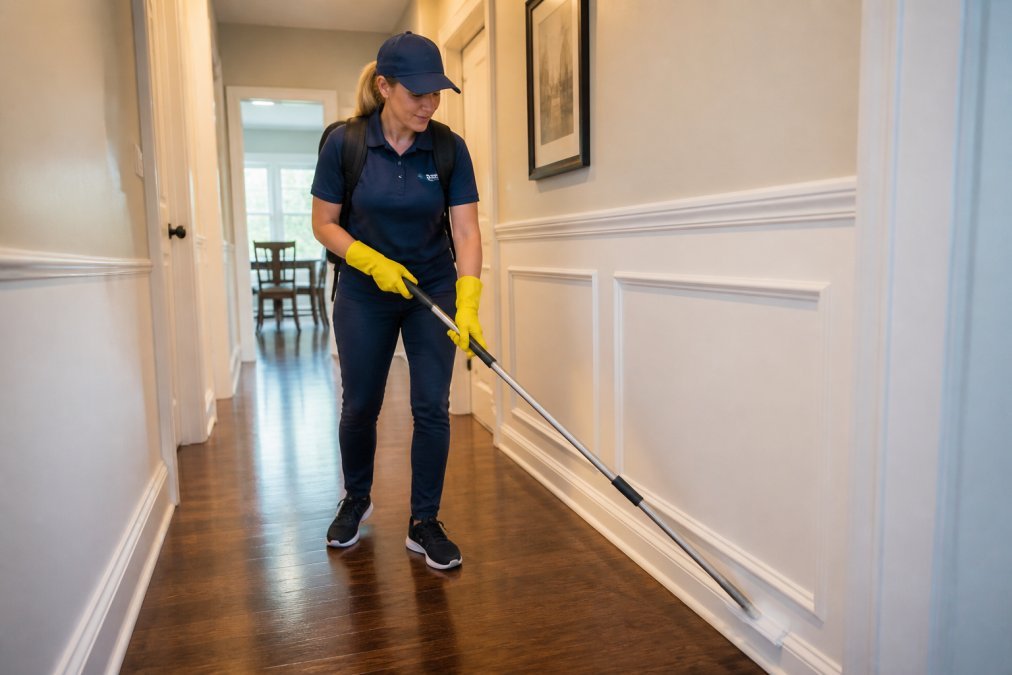
Professional cleaner using an extendable wand tool with proper upright posture to clean along baseboards in a bright residential hallway
Step-by-Step Baseboard Cleaning Without Physical Strain
Step 1: Vacuum first (2 min), Remove loose dust and pet hair with a cordless or handheld vacuum. Step 2: Prepare solution (3 min), Mix warm water with non-toxic cleaner or vinegar-water. Dampen microfiber cloth. Step 3: Attach cloth to wand (1 min), Secure cloth to keep hands away from baseboard. Step 4: Work systematically (10-15 min), Move along baseboards in straight lines with gentle pressure. Let cloth sit on scuffs for 10 seconds. Step 5: Dry as you go (5 min), Follow with dry cloth to prevent water marks. Total: 20-30 minutes.
Pro Tip Microfiber cloths grab dust electrostatically, meaning they work without chemical cleaners. Rinse them in cool water after use and air-dry, never use fabric softener, which clogs the fibers.
Cost-Benefit Analysis: DIY vs. Professional Edge Cleaning
The decision between DIY and professional service requires actual numbers, not assumptions. Here's how the math breaks down across different household scenarios.
DIY Equipment and Supply Costs
Startup costs: extendable mop system ($25-$50), microfiber cloths ($15-$25), non-toxic cleaner ($6-$12), handheld vacuum ($80-$150). Total: $126-$237. Recurring costs are minimal: $0.50-$1.50 per cleaning session.
Time Investment and Hidden Costs
Monthly DIY cleaning takes 20-30 minutes per session (4-6 hours annually). Opportunity cost: at $35/hour, that's $210 annually; at $50/hour, $300+. Pet owners need bi-weekly cleaning (15-20 hours annually), raising opportunity cost to $750-$1,000.
Professional Service Cost Structure
Professional edge cleaning costs vary depending on the scope of work and frequency. Recurring contracts may offer discounts.
Break-Even Analysis by Household Type
Single professional, no pets: DIY $216-$228 annually vs. professional quarterly $600-$1,200. DIY wins unless convenience is priority. Dual-income with one pet: DIY $518-$536 vs. professional bi-weekly $3,600-$9,600. DIY saves $3,000-$9,000 but professional eliminates strain. Mobility limitations or severe shedding: Professional service is the only practical option.
The Real Decision Framework
Choose DIY if you have 30 minutes monthly, earn under $40/hour, have no mobility issues, and don't mind repetitive tasks. Choose professional service if you have pets, experience back pain, or value time.
Safety Protocols for Chemical Sensitivities
Chemical sensitivities affect an estimated 30% of the population. If anyone experiences headaches, respiratory irritation, skin reactions, or asthma flare-ups during cleaning, chemical-free protocols are medically necessary.
Identifying Chemical Sensitivity in Your Household
Common symptoms include respiratory (coughing, wheezing, congestion), neurological (headaches, brain fog), dermatological (rashes, hives), and systemic (fatigue, nausea). Key diagnostic clue: symptoms improve within 30 minutes of leaving the room. Children and elderly are at higher risk due to developing lungs and compromised respiratory function.
Why Conventional Cleaners Trigger Reactions
Commercial cleaning products contain volatile organic compounds, chemicals that evaporate at room temperature and become airborne. Common culprits include:
Limonene (citrus scent): Reacts with ozone to form formaldehyde
Ammonia: Irritates mucous membranes and respiratory tissue
Bleach (sodium hypochlorite): Releases chlorine gas, especially when mixed with other cleaners
Phthalates: Plasticizers that off-gas and accumulate in lung tissue
Quaternary ammonium compounds (quats): Antimicrobial agents linked to asthma development
These chemicals don't just irritate during cleaning, they accumulate in your home.
Safe Alternatives for Chemically Sensitive Households
Vinegar and Baking Soda (Safest Option)
White vinegar and baking soda are genuinely inert for sensitive individuals. They don't off-gas, don't accumulate, and don't trigger respiratory or neurological responses.
Mix equal parts white vinegar and water in a spray bottle
Sprinkle baking soda directly on baseboards
Spray the vinegar solution onto the baking soda
Let sit 10 minutes (the reaction helps lift grime)
Wipe with a damp microfiber cloth
Rinse with plain water to remove any residue
Water Alone (Microfiber Method)
Dampen a microfiber cloth with plain water only
Wipe along baseboards in straight lines
Dry immediately with a second cloth
EPA Safer Choice Certified Products
Contain no carcinogens, reproductive toxins, or endocrine disruptors
Use biodegradable surfactants
Minimize VOC emissions
Undergo third-party testing
Ventilation and Application Protocols
Even with natural cleaners, proper ventilation prevents dust disturbance from irritating airways:
Open windows before cleaning, Create cross-ventilation by opening windows on opposite sides of the home
Run exhaust fans, Bathroom and kitchen exhaust fans pull air out of the home
Keep sensitive household members in another room, If someone has severe sensitivities, have them leave during cleaning and for 30 minutes after
Avoid cleaning during high-pollen days, If anyone has allergies, combine indoor dust with outdoor pollen exposure
Clean in the morning, This allows time for air to clear before bedtime, when respiratory symptoms often worsen
Critical Safety Warning: Never Mix Cleaners
This cannot be overstated: mixing vinegar with bleach or ammonia creates toxic chlorine gas, even in trace amounts. If you've used conventional cleaners previously:
Rinse baseboards thoroughly with plain water
Let them dry completely (at least 2 hours)
Ventilate the room for 30 minutes
Only then apply vinegar-based solutions
When to Use Professional Services
For households with severe chemical sensitivities, asthma, or multiple affected members, professional cleaners trained in chemical-free protocols are worth the investment. Request:
Confirmation they use only water, vinegar, or EPA Safer Choice products
Advance notice so sensitive household members can leave during cleaning
References from other chemically sensitive clients
Written documentation of all products used
Maintaining Clean Edges Between Deep Cleanings
The difference between spotless baseboards and dingy ones comes down to frequency, not effort. Light maintenance prevents heavy buildup.
Frequently Asked Questions
What are the best tools for cleaning tight corners and edges?
Cordless stick vacuums with crevice tools, robot vacuums with edge-mopping technology, and handheld vacuums excel at reaching tight corners. For manual cleaning, extendable wands with microfiber pads eliminate bending. Cordless models like the Dyson V15 Detect and Shark Stratos offer strong suction specifically designed for edge debris, while robot vacuums like the Roborock S8 MaxV Ultra automate the process with specialized side brushes that extend into corners.
Are there natural alternatives to chemical cleaners for baseboards?
Yes. Vinegar and baking soda create an effective non-toxic solution for baseboard cleaning without harsh chemicals. Mix equal parts white vinegar and water in a spray bottle, apply to baseboards, and wipe with a microfiber cloth. For tougher grime, sprinkle baking soda first, spray the vinegar solution, and let sit for 10 minutes before scrubbing. Commercial options like Seventh Generation All-Purpose Cleaner and Method Wood Floor Cleaner offer plant-based, eco-friendly formulas that are safe for pets and indoor air quality.
How often should you perform deep edge cleaning in your home?
Most homes benefit from deep edge and baseboard cleaning every 3 to 6 months, depending on foot traffic, pets, and dust accumulation. High-traffic areas and homes with shedding pets may need quarterly cleaning. Between deep cleanings, weekly spot cleaning with a handheld vacuum or microfiber cloth prevents dust and allergen buildup along edges. Regular maintenance reduces the effort required during deep cleaning sessions and maintains better indoor air quality.
What's the difference between DIY edge cleaning and hiring professional cleaners?
DIY edge cleaning requires time, physical effort, and equipment investment. Professional cleaners bring specialized tools, experience with various surfaces, and efficiency that saves hours of labor. For homeowners with mobility concerns, pets, or busy schedules, professional services eliminate physical strain and ensure thorough, consistent results. Many find the time savings and peace of mind worth the investment, especially for properties like Airbnbs requiring frequent turnovers between guests.